What industry is the application of automatic matrix sorting chute in
The automatic matrix sorting chute is widely used in industries such as express logistics, e-commerce warehousing, pharmaceutical cold chain, book retail, 3C electronics, manufacturing, and air luggage due to its modular design, high drop non powered conveying, and low energy consumption. Its core solution is high-throughput sorting, efficient space utilization, and cargo damage control. The follo
The automatic matrix sorting chute is widely used in industries such as express logistics, e-commerce warehousing, pharmaceutical cold chain, book retail, 3C electronics, manufacturing, and air luggage due to its modular design, high drop non powered conveying, and low energy consumption. Its core solution is high-throughput sorting, efficient space utilization, and cargo damage control. The following provides a specific explanation of its application value and adaptation points based on industry scenarios:
Core application industries and landing scenarios
1. Express logistics (core mainstay)
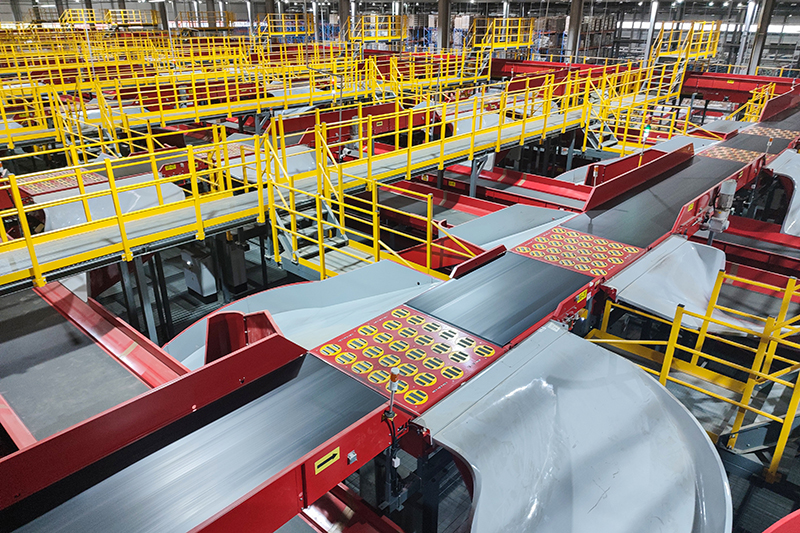
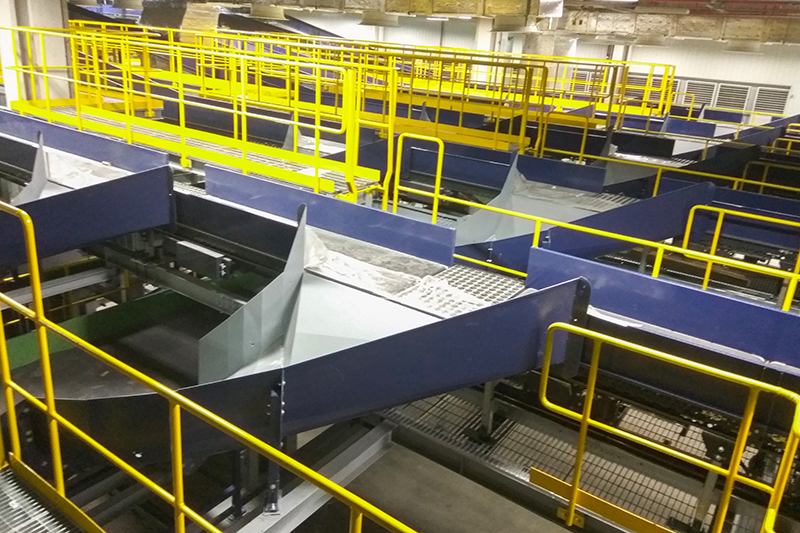
The matrix area of the transfer center is initially divided into medium and large items, with a three-layer line body and spiral chute to achieve "high-level incoming line - directional sorting - low-level outgoing line", suitable for daily processing of millions of items.
The loading area is connected to a telescopic machine on the side, and the balance wheel is diverted into the telescopic machine through a sliding groove to improve loading efficiency; The small item sorting area, in conjunction with the cross belt sorting machine, is connected to the grid chute and supports rapid collection of bags.
Typical value: Sorting accuracy reaches 99.99%, saving 80% of electricity, and reducing damage rate to less than one in ten thousand.
2. E-commerce and Retail Warehousing
Peak promotion processing: Dynamic speed regulation to 2.3m/s, production capacity increased by 40%, replacing manual lines to cope with peak orders.
Multi category adaptation: Extended chute for clothing returns, fluent shelf chute for shoes and boots, low friction module chute for books/cosmetics, reducing the jamming rate of irregular parts.
Cross border parcel sorting: integrating visual scanning to improve waybill recognition rate and adapt to international logistics route segmentation.
3. Medicine and Cold Chain
Low temperature environment adaptation: -18 ℃ cold storage maintains an efficiency of 6000 pieces/hour, anti frost coating groove reduces jamming, and is suitable for isothermal control of vaccines and biologics.
Compliance and Safety: Food grade materials+antibacterial coatings, compliant with GMP, used for non powered transportation of drugs and fresh produce, reducing the risk of cross contamination.
Typical value: Non powered design reduces energy consumption in cold storage, with a cargo damage rate controlled below 0.02%.
4. Books and 3C Electronics
Book delivery: Flexible chute for sorting hardcover books, with a damage rate reduced from 0.8% to 0.02%, suitable for multi specification book sorting.
3C Electronics: Anti magnetic and anti-static material groove, avoiding magnetic products such as mobile phones and hard drives from being adsorbed/bumped, reducing the damage rate by more than 90%.
5. Manufacturing and Parts Distribution
Automotive/home appliance components: matrix coarse sorting+multi grid subdivision, suitable for production line distribution of different SKUs, improving the efficiency of replenishment in line side warehouses.
Lightweight conveying: No power chute reduces workshop energy consumption, modular design quickly adapts to production line adjustments, and supports JIT distribution.
6. Air luggage and postal services
Airport luggage sorting: High drop spiral chutes connect different floor conveyor lines, adapting to diverse luggage sizes and improving sorting and loading efficiency.
Postal letters/packages: The matrix layout achieves subdivision of directions in multiple areas, combined with cross belt sorting machines to increase processing capacity and reduce labor costs.

 18151596636


 Home
Home
 Product
 Wechat
 Telephone